

Marketing concepts and terms
There are many different types of marketing efforts used by a variety of different sectors, such as:
- Retail marketing
- Fundraising
- Brand marketing
- Membership
- Issue awareness
- Event marketing
- Calls to action
Each of these forms of marketing uses a series of principles and practices to meet their goals. The principles discussed in the following topics reference database marketing practices for the not-for-profit sector. These are general, high-level concepts, but each organization performs marketing in a unique manner.
Marketing integration across iMIS
With iMIS Marketing, you can:
- Designate appropriate orders and donations as responses to the campaign
- Send personalized acknowledgments to the contact using their preferred method of communication
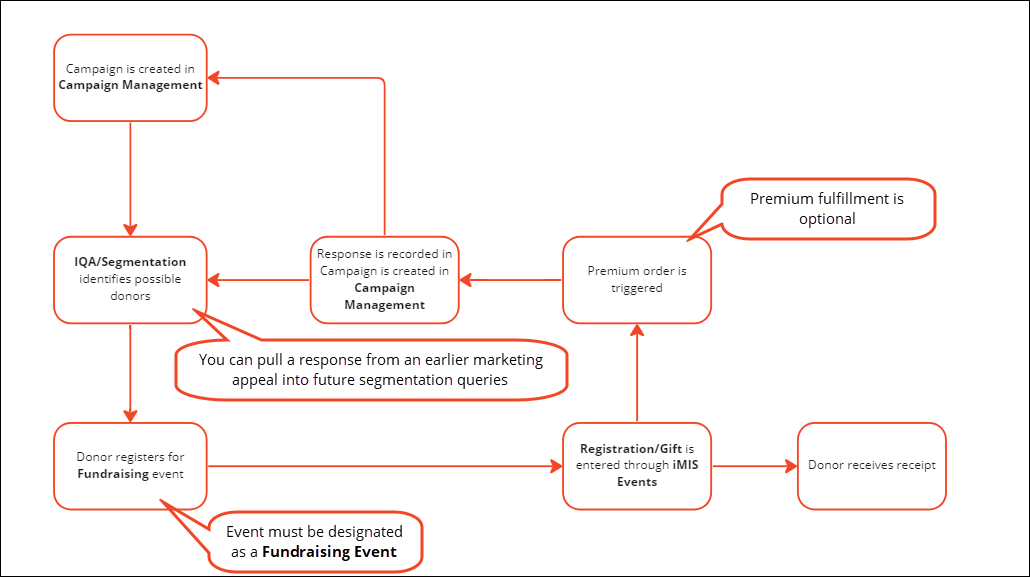
The following diagram illustrates the advanced integration that is possible between Campaign Management and other iMIS features.
Basic and closed-loop marketing principles
Being customer-focused means that marketing efforts need to balance the goals of the organization with the needs of their "customers" (contacts, members, donors, prospects, legislators).
Customer satisfaction is a key metric that organizations seek to determine. Respect for the customer is the key to maintaining high customer satisfaction ratings. Ways to measure customer satisfaction include:
- Conducting a survey – Extract a list from your database, develop customer satisfaction questions, call or send the survey to your customers, record the responses, and analyze the results.
- Integrating short surveys into your customer service activities – Add questions to a donor reply device or a membership renewal package.
- Offering a survey on your website.
- Encouraging your customer service staff to ask questions when they are on the phone with your customer and to record the answers.
The closed-loop marketing approach measures the results of marketing and communication initiatives by tracking the response of targeted groups. The results of responses, such as completed surveys, are added to a database for tracking and evaluation to improve future marketing decisions. Simply put, marketers can develop and monitor targeted strategic campaigns based on a wide variety of customer histories and behaviors.
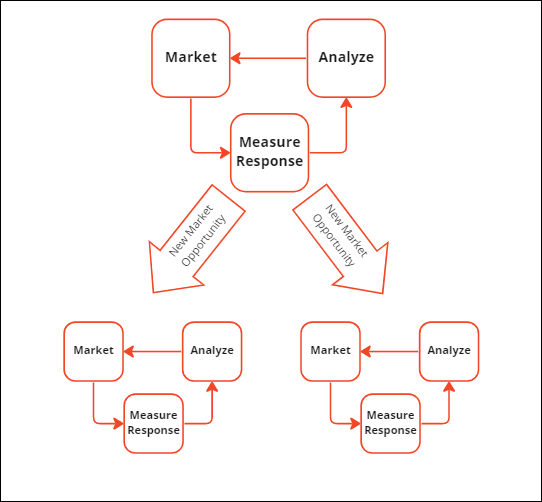
Closed-loop marketing involves a never-ending cycle of ongoing analysis, ongoing marketing, and ongoing response management. New market opportunities are identified through trend analysis. A new opportunity might address a weak area within a marketing plan or might identify a new group.
Closed-loop marketing refers to the cycle of:
- Developing metrics and benchmarks for the desired transactional behavior.
- Ensuring that business processes are in place to maximize the customer's experience and to build loyalty.
Source Code assignments fall into three basic categories:
- Codes assigned to outgoing marketing efforts to track the incoming responses
- Generic codes assigned to the ongoing 'passive' ways in which a customer can support an organization, such as web transactions, social media interactions, or emails
- Unknown codes that are assigned to capture responses when the actual source code is not known
Source code tracking is important. To maintain the highest possible accuracy in recording the actual source code assigned to a contact's response, key processes must be highlighted.
It is important to test your organization's marketing plan. Review the following best practices:
- Test groups must be measured against a control group.
To accurately determine whether a test is successful, it should be repeated. Future campaigns should repeat the test on new groups of randomly selected records. After the test has produced similar results three or four times, consider increasing the size of your test groups and introducing your new tactic on a permanent basis.
Terms to know: Campaign Management
The following terms and phrases associated with campaign management. See the Glossary for full definitions.
|
|
Updated 3 months ago