

Understanding the GL entries for check refunds
The GL journal entries recorded in iMIS for check and credit card refunds are different, because iMIS assumes for check refunds, a separate accounting package is involved.
Why journal entries are recorded the way they are when check refunds are issued
The journal entries that iMIS generates primarily deal with those that record income, cash receipts, and accounts receivable, which are traditionally processed by the accounts receivable functionality within an overall accounting software package.
The separate accounting package will generate the entries to record expenses, payments associated with paying vendors, and entries to accounts payable. iMIS provides a General Ledger export, so that the journal entries that iMIS generates can be imported into the separate accounting package. Exporting the transactions from iMIS and into an accounting package ensures that all the journal entries of all types, and from all sources, come together so that the necessary accounting reports can be generated.
When a refund check is issued, iMIS assumes that the accounts payable aspects of the separate accounting package was used to generate, and account for, that refund check. Therefore, it would be the separate accounting package that would generate the GL Journal entry to credit the Cash in Bank account for the refund check. If iMIS were to also generate a credit entry to Cash in Bank, then that would cause the balance in the Cash account to be wrong, because there would be two credit entries to cash, instead of one, for each check refund.
If an EFT transaction was generated outside of iMIS, then the same principle is in place. The expectation is that some other accounting package is responsible for crediting the Cash in Bank account, so iMIS will not duplicate that entry.
Understanding the GL entry difference between credit card and check refunds
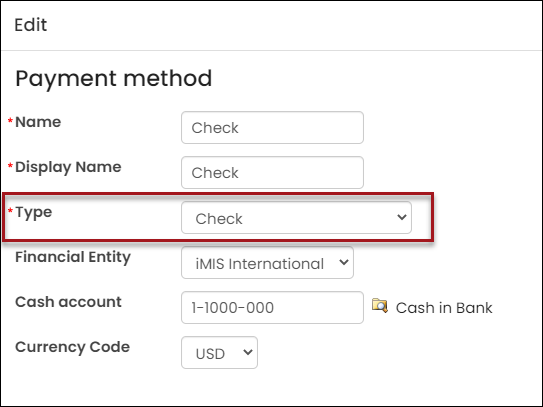
The payment Type that is selected in the Payment method drives how GL entries are recorded in iMIS.
Credit cards
All credit card payment refunds are processed directly through iMIS; because of this procedure, no other accounting system is involved in recording a GL journal entry for this type of refund. When the Payment method selected for recording the refund has a type of Credit card, then iMIS knows that iMIS is the only place where that refund transaction will actually be recorded.
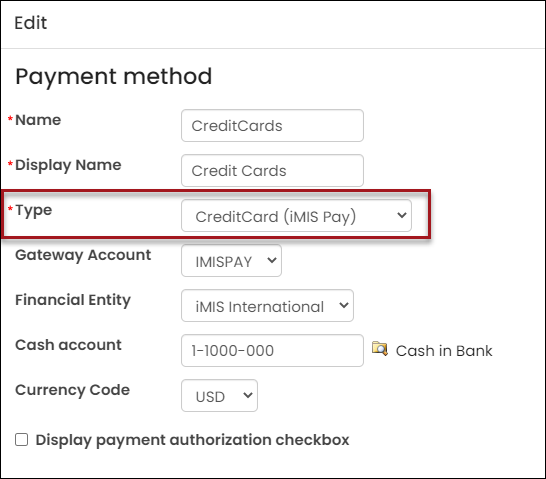
For that reason, iMIS credits the Cash in Bank account directly whenever a refund is recorded and a credit card payment method is assigned to that refund.
Checks
If you change the payment method when you record the refund to Check, then iMIS can only assume that you departed from the normal approach of matching the refund method to the same form of payment employed by the payment being refunded.
In this scenario, iMIS assumes that you opted to generate a paper check refund (or perhaps an EFT check refund) through a separate accounting package instead of processing the refund through the gateway. There is absolutely no way for iMIS to be able to tell otherwise. Whenever the payment method assigned to the refund has a payment Type of either Check or Cash, then iMIS will credit the Refund Clearing account instead of the Cash Account when generating the journal entry to record the payment.
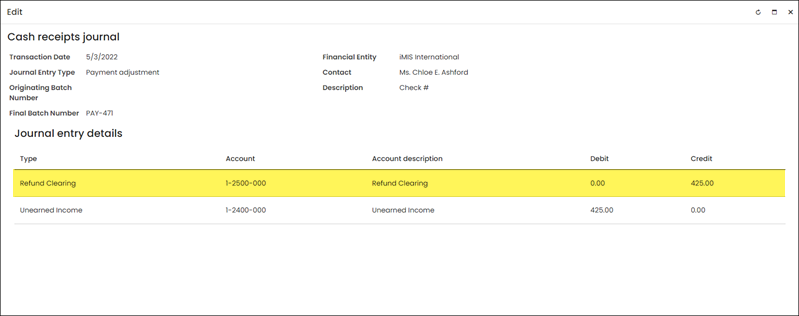
The expectation is that the user who generates the entry to record the Accounts Payable (or the outright Check) transaction in the separate accounting software package will assign the same Refund Clearing account when entering the accounts payable entry to be used for generating the refund check.
If writing a manual check, the manual check needs to be accounted for via a journal entry that would need to be recorded in the separate accounting package. In either case, the Refund Clearing account needs to be recorded as the debit entry as an offset to either Accounts Payable or Cash in Bank.
Updated 5 months ago